

🤔How DO you Design for Circularity?! 🧵
Learn More in my Bi-Weekly Newsletter


Welcome to Better Together’s bi-weekly newsletter, where we believe that the more we work together, the greater impact. Written by Rachel Ceruti, of FABSCRAP.
Y’all - SORT-A-THON is tomorrow (Saturday 4/11) - have you grabbed your ticket yet? - so apologies for this being a shorter newsletter.
Quick answer: Join FABSCRAP’s Textile Intensive and/or Earth Day Social 🌎
to gain practical, hands-on experience and learn how to design for circularity!

If FABSCRAP knows one thing, it’s circular textiles.
So we developed an intensive course to share this knowledge with our community.
Basically, we want y’all to gain confidence with textiles, whether you’re a designer, sustainability professional, or consumer!
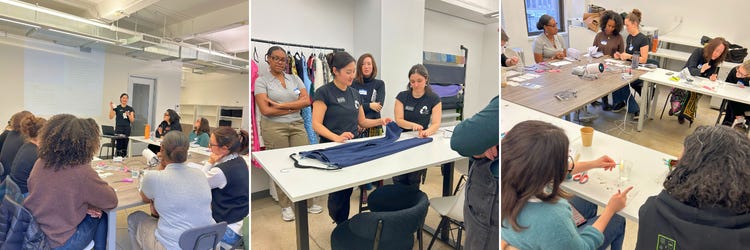
Starting the evening of Monday, April 20th, we’ll be diving into fibers types, weaves, knits with burn tests to identify fibers AND actual basic weaving and knitting activities.
The next evening, Tuesday, we’ll go a step further and explore the recyclability and circularity of various textiles. Decoding colloquial language versus industry terms and empowering you to make strategic decisions that improve product longevity, reduce waste, and advance circular practices!
The last evening, Wednesday, actual Earth Day, is our SOCIAL! This is included in the Textile Intensive BUT you can also purchase a ticket for just this event.
Doors open at 5:30 and the panel starts at 6.
The panel, Designing for Circularity: Sourcing, Recycling, and Resale, starts at 6! Learn from industry insiders about how they’re designing for circularity.

Lisa Diegel, Director of Sustainability & Impact at Faherty Brand*, on translating circular principles into practice within a growing apparel company
*Host for this party!
Mary Bemise, Founder of Reprise Activewear, on building a small brand with intentional material sourcing and sustainability at its core
Constanza Gomez, Co-Founder of Sortile, on what actually happens to textiles after use and the realities of making recycling work
Then, keep the party going, with
🍹Delicious drinks from Barrow’s Intense Ginger Liqueur
Tabling & shopping from
🔗Textile Resources
Go for the sustainability, stay for the view.
Interest read on the need for new "recycled" codes for customs/global trade
My current obsession: The New Textile-to-Textile Recycling Map
I personally enjoyed the bit below “Around the world in 80 shipments”
EPR News: California Responsible Textile Recovery Act (SB 707) Implementation Tracker
Once a Sweatshop, Now a Lab for Life: Studying Inside the Triangle Shirtwaist Site
Has anyone tried this swapping platforms?
TEXTILE INTENSIVE — 3-day hands-on course to build your confidence in textiles
Whether you’re a designer, product developer, sustainability professional, or just… a person who wears clothes, this will genuinely change how you see textiles. From burn tests to identify fiber types to literally weaving and knitting—and that’s just day one—we go far beyond the typical textile course. On day two, we dig into real-world application, recyclability, and circularity principles. Honestly, you won’t find this anywhere else.April 20th, 21st, & 22nd @ 6-8p
EARTH DAY SOCIAL — where my party people at?
We wanted to create an event for our community to celebrate FABSCRAP, Earth Day, and each other. And yes, I’m biased because I helped create this—but it’s going to be a banger. If you’re reading this, we probably agree that a “banger” party means learning something new, meeting cool people, having some food and drinks… and being home by 9. WE GOT YOU.April 22nd @ 6-8p
👁️ Deep Dives
“MORE WASTE”
The World Bank’s new “What a Waste 3.0” report reveals that by 2050, global waste could surge 50%, with plastics and textiles topping the mismanaged pile. From overflowing landfills to missed recycling opportunities in low-income countries, the study highlights both the crisis and the chance to rethink how we produce, use, and dispose of materials. Dive into the full report to explore actionable solutions for a cleaner, more sustainable world.
—
“CHILDREN”
The only touch points children have with the fashion systems is consumption (or more depressing, production). How can we expect system change when the ‘future’ is repeating the past? I’ve recently discovered Lucia Cuba’s research, Fashion Playspace, a multigenerational space where children engage with fashion critically and playfully (through material exploration, repair, sorting, reuse, garment construction, conversations about clothing’s social and environmental dimensions, among other forms). It’s a really cool website and I’m pretty sure my next, next deep dive will touch on this!
—
Thanks for reading y’all! Hope to see you around the warehouse soon.